Online Canadian Criminal Record Checks
Run reliable criminal record checks in minutes
Hire Performance makes it easy to screen with confidence. Our
online criminal record checks are delivered quickly and
accurately with fully compliant results all within our secure eScreener platform.
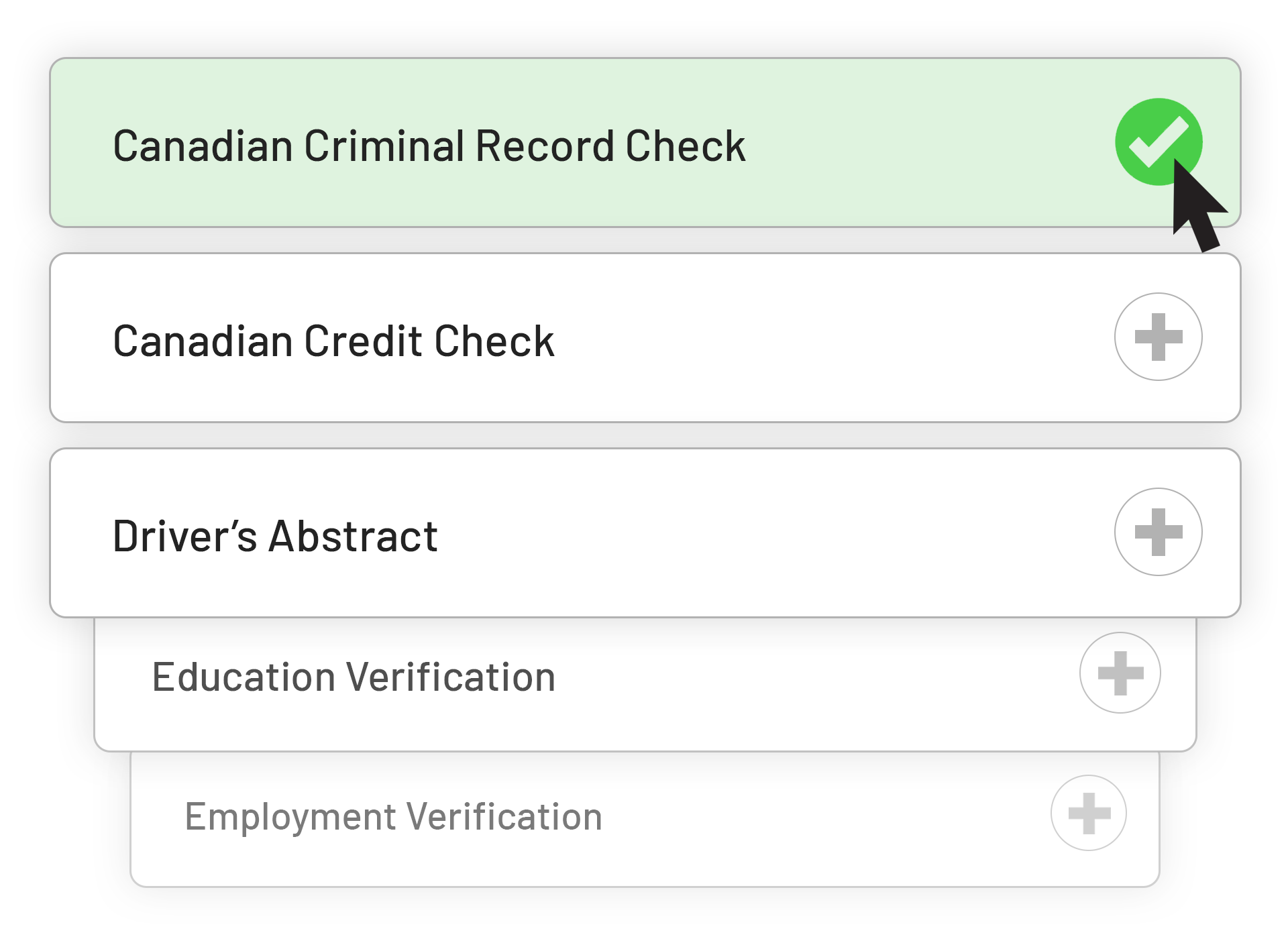



Criminal Background Checks with Hire Performance
Hire Performance’s Canadian Criminal Record Checks, also known as CPIC or CCRC, protect your business by helping you select safe, honest, and reliable employees while protecting your organization from individuals with undisclosed pasts.
There are 3 types of pre employment backgroud checks in Canada.
Level 1
CPIC
Standard Criminal Record Checks
This check searches the National Repository of Criminal Records, maintained by the RCMP, through the Canadian Police Information Centre (CPIC) system. CPIC is the national database used by police services across Canada to access criminal records and related information. This database contains adult criminal convictions where no pardon or record suspension has been granted.
Level 2
EPIC
Enhanced Criminal Record Checks
An Enhanced Criminal Record Check—professionally known as a Criminal Record and Judicial Matters Check (CRJMC) or an EPIC—is a comprehensive Level 2 screening solution. It includes a standard Level 1 CPIC check of the RCMP’s National Repository plus a Local Police Information (LPI) search. While a basic check only shows convictions, our Enhanced CRJMC uncovers critical judicial matters, including pending charges, warrants, and active court orders, providing the highest level of third-party screening available in Canada.
Level 3
VSC
Vulnerable Sector Checks
The Vulnerable Sector Check includes both Level 1 and Level 2 searches, along with a review for sexual offences under Schedule 1 of the Criminal Records Act that are subject to a record suspension (formerly a pardon). VSCs cannot be obtained through third-party companies and are only available directly from the police.
Canada’s leader in criminal record checks
For over 20 years, Hire Performance has been one of the top trusted Canadian criminal record check companies, completing hundreds of thousands of online criminal background checks for businesses, not-for-profits, and individuals across the country. As a 100% Canadian-owned company, all backchecks are handled by our in-house team, with data securely stored on Canadian servers, never outsourced.

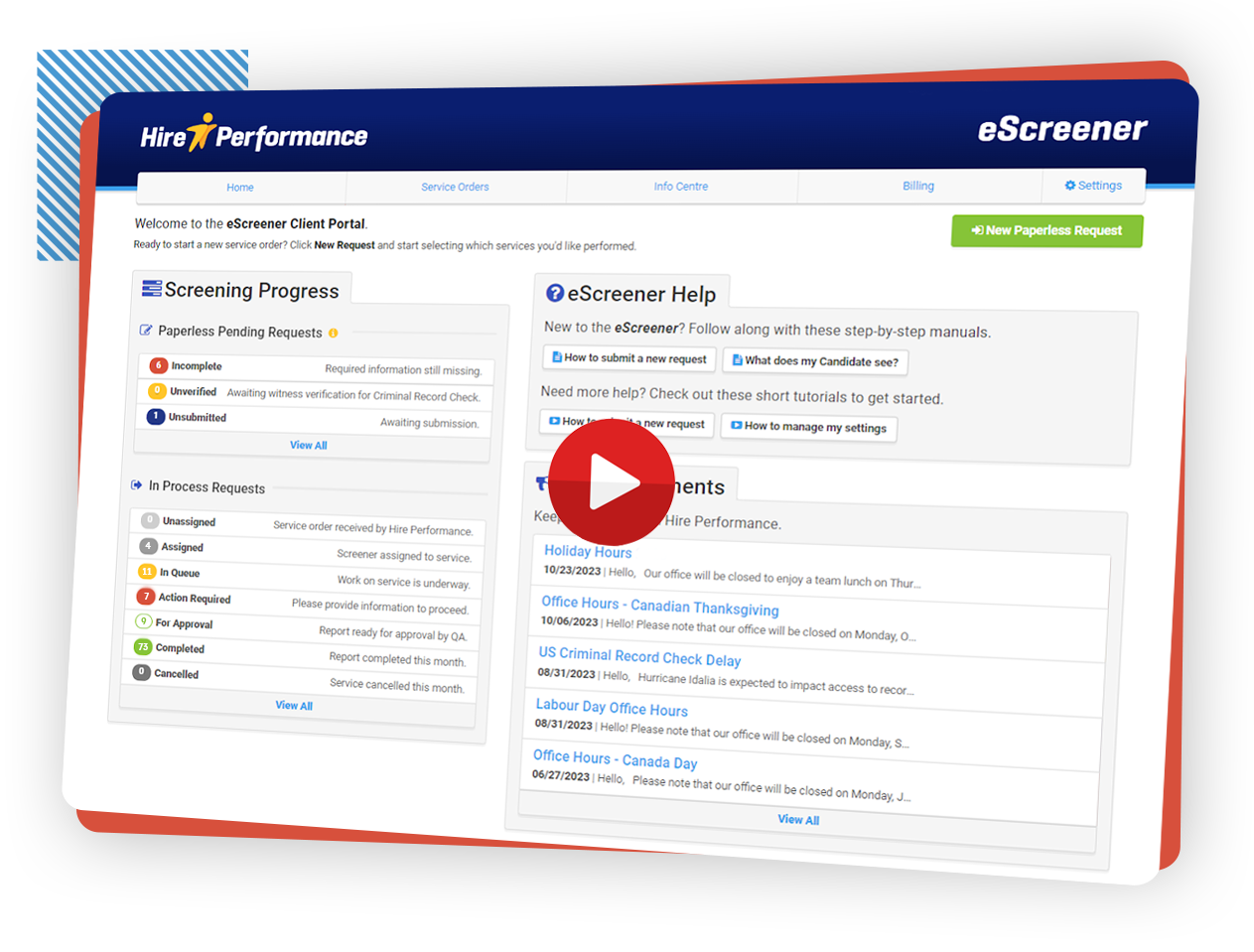
Simple, secure & compliant screening
An employee background check gives you the insight needed to make effective hiring decisions and manage your business with confidence. Our background screening and backcheck services help create a safe workplace by identifying risky hires, protecting assets, maintaining your reputation, and mitigating client risks.
All Employment Screening processes on the eScreener are accurate, secure, and fully compliant with PIPEDA, provincial privacy laws, and human rights legislation.
Need more than a standard check?
Our
Enhanced Criminal Record Check
(CPIC + PIC) includes everything in a standard check plus outstanding charges, warrants, judicial orders, peace bonds, probation, negative police contacts and more! Ideal for positions of trust, safety-sensitive roles, and working with vulnerable persons.


Looking to run U.S. and international criminal record checks?
Whether you need an Ontario Criminal Record Check or are hiring in Alberta, B.C., or anywhere else in Canada, our nationwide coverage ensures fast, compliant, and accurate background screening every time. For companies with cross-border hiring needs, we also provide U.S. Criminal Record Checks and International Background Checks for complete global compliance.
COAST TO COAST
Criminal Record Checks Across Canada
Criminal record checks are governed federally through CPIC, but each province has its own terminology, policing structure, and in some cases its own legislation. Here is what is distinctive about screening in each province, and what to know before requesting a check.
Ontario
The most tightly regulated record-check regime in Canada
Legislation
Governed by the Police Record Checks Reform Act, which standardizes what each check can disclose.
Policing
43 municipal police services plus the OPP, more than any other province.
Check types
Criminal Record Check (Level 1) and Criminal Record and Judicial Matters Check (Level 2 / CRJMC), both available through our eScreener.
Quebec
Bilingual screening under Law 25, with strong Charter protections
Legislation
Law 25 governs private-sector data with strict consent and provincial-grade handling requirements.
Policing
Sûreté du Québec provincially, with the SPVM in Montreal and other municipal services.
Check types
Standard and vulnerable sector checks, delivered through bilingual candidate workflows.
Considerations
Section 18.2 of the Quebec Charter bars refusing or penalizing a candidate over a conviction unrelated to the job, a broader protection than most provinces offer.
British Columbia
Provincial privacy law and a fragmented policing landscape
Legislation
The provincial Personal Information Protection Act (PIPA) governs private-sector data handling alongside PIPEDA.
Policing
Around a dozen independent municipal departments, including the VPD, with the RCMP providing provincial and contract municipal coverage.
Check types
Standard and enhanced (vulnerable sector) checks through CPIC and local police records.
Alberta
PIC checks that reach into provincial court records
Legislation
Alberta's Personal Information Protection Act (PIPA) governs private-sector data handling alongside PIPEDA.
Policing
Independent municipal forces including Calgary, Edmonton, Lethbridge, Medicine Hat, Camrose, and Taber; the RCMP covers the rest.
Check types
The Police Information Check (PIC) searches CPIC, the provincial JOIN court system, and local police records.
Saskatchewan
CPIC and local records, with sector-specific licensing
Legislation
Federal PIPEDA applies; there is no province-specific private-sector privacy statute.
Policing
Municipal services in Regina, Saskatoon, Prince Albert, Moose Jaw, Estevan, and Weyburn; the RCMP serves the rest.
Check types
Police information checks combine CPIC with local police records; vulnerable sector checks run through municipal services.
Considerations
Sector licensing regimes such as cannabis retail, gaming, and security can add their own screening requirements.
Manitoba
Provincial abuse registries layered onto police checks
Legislation
Federal PIPEDA applies; there is no province-specific private-sector privacy statute.
Policing
The Winnipeg Police Service serves the capital; the RCMP covers most of the province.
Check types
Police Criminal Record Check (PCRC) and Police Vulnerable Sector Check (PVSC) through the WPS.
Considerations
Manitoba maintains its own Adult Abuse Registry and Child Abuse Registry; roles working with vulnerable people often require these in addition to a police check.
Nova Scotia
Mixed RCMP and municipal policing
Legislation
Federal PIPEDA governs private-sector data handling.
Policing
Halifax Regional Police and Cape Breton Regional Police lead, with smaller municipal services in Truro, Amherst, Kentville, and Bridgewater; the RCMP covers the rest.
Check types
Standard and vulnerable sector criminal record checks.
Considerations
Growing international immigration often makes out-of-country checks a useful supplement to Canadian screening.
New Brunswick
Canada's only officially bilingual province
Legislation
Federal PIPEDA governs private-sector data handling.
Policing
Municipal services in Fredericton, Saint John, and Bathurst, alongside RCMP coverage including Codiac Regional RCMP in Moncton.
Check types
Standard and vulnerable sector criminal record checks.
Considerations
As the only officially bilingual province, compliant screening should support both English and French candidate workflows.
P.E.I
A small market with RCMP and four municipal services
Legislation
Federal PIPEDA governs private-sector data handling.
Policing
RCMP "L" Division provincially, with municipal services in Charlottetown, Summerside, Borden-Carleton, and Kensington.
Check types
Standard and vulnerable sector criminal record checks through CPIC and local records.
Newfoundland and Labrador
A distinctive two-force provincial policing model
Legislation
Federal PIPEDA governs private-sector data handling.
Policing
The Royal Newfoundland Constabulary (RNC) covers St. John's, Corner Brook, Churchill Falls, and Labrador City; the RCMP serves the remainder.
Check types
Standard and vulnerable sector criminal record checks.
Considerations
Offshore oil and gas operators often fold criminal record screening into broader pre-employment programs.
Canadian Criminal Record Checks
Hire Performance processes criminal record checks for all 10 provinces through our PIPEDA-compliant eScreener. National coverage, Canadian data residency, and over 40 years of provincial expertise.
Criminal Record Check FAQs
What information is typically included in a criminal record check?
Our criminal record checks (often refered to as a criminal background check or background screening or pre-employment screening) includes a complete report of an applicant’s prior conviction history in Canada since 1998.
Each report gives you access to information stored in the Canadian Police Information Centre (CPIC) database managed by the RCMP, so you get relevant and accurate information on potential hires of your company.
These police checks provide an indication of the existence of criminal convictions, for which a pardon has not been granted, within the RCMP National Repository of Criminal Records. Any information discovered will be as the record exists on the date of search.
How long does a criminal background check take?
When you're making hiring decisions, you need information fast. That’s why our eScreener paperless platform delivers most Canadian criminal record check results in 1–2 hours or less, with many online searches completed in as little as 15 minutes.
Our streamlined process helps employers obtain a Canadian criminal record check quickly and securely, reducing delays in hiring and onboarding. Once complete, results are delivered directly through eScreener’s secure online platform, giving you instant access to the information you need to make confident hiring decisions.
What is background screening?
Background screening refers to the process of researching and gathering information about an individual's history, often to make informed decisions about their suitability for employment, tenancy, financial transactions, or other situations where trust and reliability are essential. Background screening aims to verify and assess an individual's qualifications, character, and past behaviour, helping organizations and individuals make more informed and risk-conscious decisions.
Why is background screening important for employers?
Employers have a duty to check the backgrounds of prospective employees for the sake of shareholders, fellow employees, and customers. A thorough background check can save an organization an enormous amount of grief and expense down the road. Hire Performance’s services accelerate the recruiting process and dramatically improve the quality of background information necessary to make well-informed hiring decisions. These benefits will significantly reduce expenses associated with turnover and re-training - not to mention the damage that a 'bad hire' can inflict on the company and its customers.
Are background checks legal?
Yes, background checks are legal, but they must be conducted in compliance with relevant laws and regulations governing privacy and employment practices. In many countries, including Canada, the United States, and others, specific laws dictate how background checks can be performed, what information can be obtained, and how many years of history can be reviewed. Employers and background screening companies need to adhere to these laws, such as the Personal Information Protection and Electronic Documents Act (PIPEDA) in Canada or the Fair Credit Reporting Act (FCRA) in the U.S., to protect individuals' rights and privacy during the screening process. You can read more about this here.
Is the CPIC & PIC the same as the CRJMC
No, the terms refer to different things, though they are related in the context of criminal record checks in Canada. The CRJMC is a specific type of police check that incorporates information from the CPIC and other local databases.
Here is a breakdown of each term:
- CPIC (Canadian Police Information Centre): This is a national police database maintained by the RCMP. A basic "CPIC check" (also known as a Level 1 check) usually provides only criminal convictions that are in the national repository.
- PIC (Police Information Check): This is a type of record check that was often the former name for what is now known as a CRJMC in many Ontario police services. It goes beyond a basic CPIC check by including outstanding charges, warrants, and judicial orders.
- CRJMC (Criminal Record and Judicial Matters Check): This is the current, formal name for a "Level 2" police check in Ontario and other jurisdictions. It is a comprehensive check intended for general employment or volunteering (but not with vulnerable persons) that includes: Criminal convictions from CPIC and local police databases. Outstanding entries like charges, warrants, peace bonds, and probation orders. Absolute and conditional discharges.
In summary, a CRJMC is a more detailed report that uses information found within the broader CPIC system, and "PIC" is often an older, synonymous term for the CRJMC.
What happens if my Ontario criminal record check identifies a record?
If an Ontario criminal record check identifies a criminal record, the information will be reviewed by the employer in the context of the position being filled. Employers typically consider factors such as the nature of the role, the responsibilities involved, the relevance of the record to the position, and any applicable legal or regulatory requirements.
In many cases, an Ontario criminal record check is just one component of a broader hiring decision that may also include employment verification, education verification, reference checks, and other background screening services. A criminal record does not automatically prevent someone from being hired, and employers are encouraged to assess each candidate fairly and individually.
If additional information or identity verification is required, the candidate may be asked to provide further documentation before the screening process is completed.